An objective, engineering-grounded comparison between Google Flutter and native iOS/Android development. Evaluate development velocity, long-term maintenance costs, and execution benchmarks.
The Mobile Development Crossroads: Two Codebases or One?
Every startup founder, chief technology officer, and product director launching a mobile application confronts a pivotal decision early in product definition: should the organization invest in two separate native engineering tracks (Swift for iOS and Kotlin for Android), or adopt a unified cross-platform framework like Google Flutter?
Historically, cross-platform technologies—such as early hybrid web wrappers—suffered from sluggish webview rendering, clunky touch responsiveness, and awkward operating system integrations. However, generational advancements in compiled cross-platform frameworks have radically transformed this landscape.
Today, Google Flutter powers mission-critical applications for global enterprises including Alibaba, BMW, Google Pay, and Nubank. Making the right architectural selection requires an objective evaluation of rendering engines, developer velocity, maintenance overhead, and total cost of ownership (TCO).
Architectural Deep Dive: How Flutter Renders Without WebViews or Native Bridges
To appreciate Flutter performance, one must understand how it differs fundamentally from both traditional webview hybrids and bridge-dependent frameworks like React Native. React Native relies on an asynchronous JavaScript bridge to communicate with native platform widgets, which can introduce frame drops during intensive animation sequences or rapid scroll gestures.
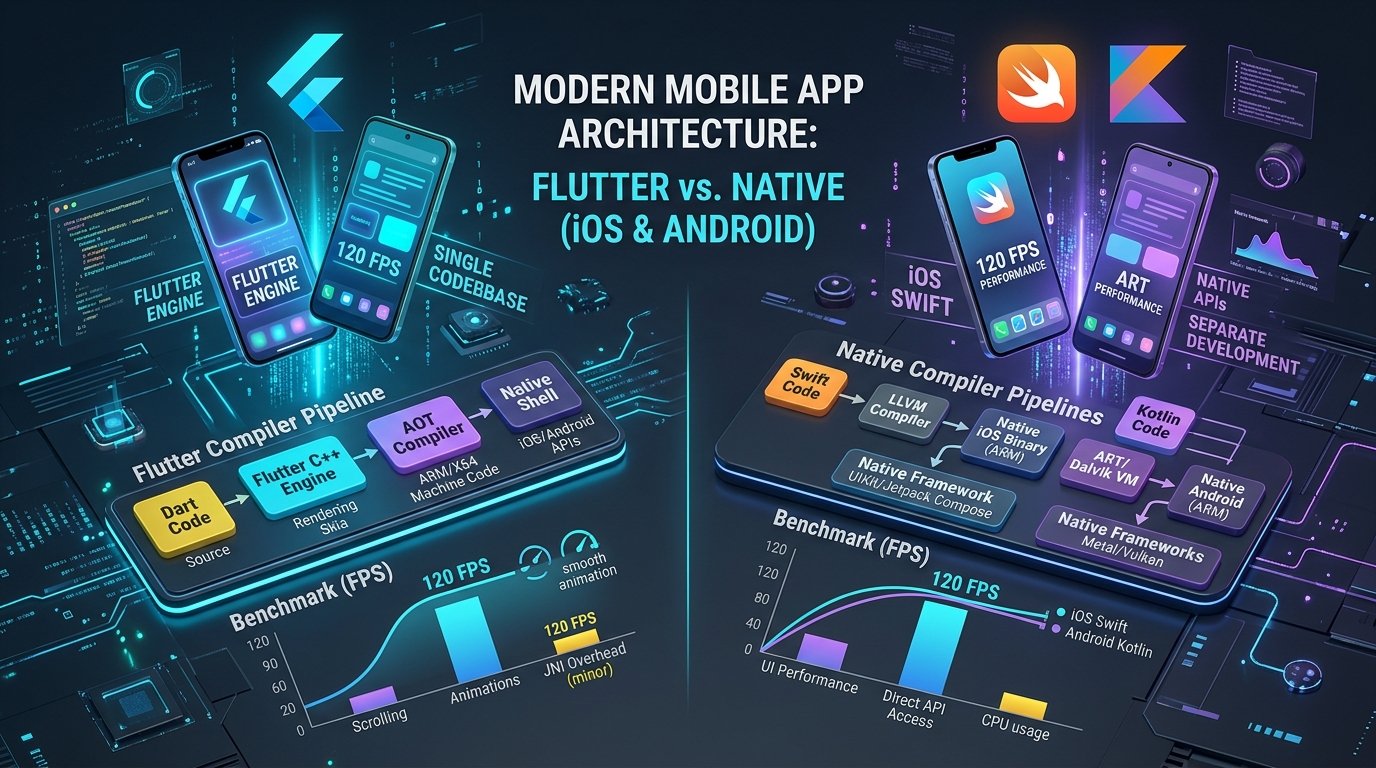
Flutter bypasses the native OEM platform widgets entirely. Instead, it ships with its own high-performance C++ graphics rendering engine (Impeller / Skia). Flutter compiles Dart code directly into native ARM machine instructions for both iOS and Android.
When rendering UI components, Flutter draws every pixel directly onto a platform Skia/Impeller canvas at consistent 60 to 120 FPS refresh rates. This architectural independence guarantees pixel-perfect visual consistency across iOS and Android, eliminating the platform-specific visual bugs that frequently delay cross-platform projects.
Financial and Velocity Analysis: The 40% TCO Advantage
For early-stage startups and growth-stage enterprises alike, capital efficiency and market speed are paramount survival metrics. Building separate native iOS and Android apps requires hiring two distinct engineering teams: iOS specialists proficient in Swift and UIKit/SwiftUI, and Android engineers experienced in Kotlin and Jetpack Compose.
This dual-team structure doubles personnel expenditures, complicates project management synchronization, and inevitably causes feature parity divergence where one platform lags behind the other in releases and bug fixes.
By standardizing on Flutter, organizations write a single, unified codebase that powers both mobile platforms alongside web and desktop targets. Practical engineering data indicates that Flutter reduces initial development time by 35% to 45% and cuts ongoing maintenance and feature release costs by approximately 40% across the application lifecycle.
When Pure Native (Swift & Kotlin) Remains the Superior Choice
Despite the compelling advantages of Flutter, there remain distinct technical scenarios where pure native development remains the optimal architecture. Applications that rely heavily on bleeding-edge platform capabilities—such as complex augmented reality (Apple ARKit / Google ARCore), low-level Bluetooth hardware peripherals, custom audio-video DSP processing, or intricate background location telemetry—benefit from direct native access.
While Flutter supports custom platform channels to bridge native code, maintaining extensive custom C++/Objective-C/Java bridges for highly specialized hardware features can erode the velocity advantage of cross-platform development.
The Verdict: Making the Strategic Decision for 2026
For over 85% of standard commercial applications—including e-commerce, fintech, healthcare, SaaS companions, social platforms, and on-demand delivery services—Flutter delivers the ideal balance of native performance, pristine UI fidelity, and rapid time-to-market.
Build Your High-Performance Mobile App with Deep11 Compusoft
Deep11 Compusoft builds world-class mobile applications for iOS and Android. Our senior engineers specialize in Flutter cross-platform development as well as native Swift and Kotlin architectures, helping you launch fast, scale effortlessly, and delight your mobile users.
Strategic Implementation Best Practices & Architectural Checklist
When executing enterprise-level projects in Mobile Apps, software architects and engineering leaders must adhere to a disciplined governance framework. Rushing deployment without standardizing code quality, automated testing, and security controls leads to compounding technical debt and production instability.
- Phase 1 — Discovery, Discovery & Schema Auditing: Conduct deep code inspections, audit relational database schemas for indexing bottlenecks, map undocumented API dependencies, and eliminate dead code paths before writing new features.
- Phase 2 — Modular Decoupling & Component Isolation: Break monolithic workflows into independently deployable, modular services using domain-driven design (DDD) principles. Establish strict contract boundaries via documented OpenAPI / Swagger specifications.
- Phase 3 — Automated CI/CD & Defensive Test Harnesses: Integrate static analysis (PHPStan / ESLint / SonarQube), automated unit and integration tests, and security linting into continuous integration pipelines to catch regressions before code touches staging environments.
- Phase 4 — Real-Time Telemetry & Observability: Deploy application performance monitoring (APM) tools, structured JSON logging, and error tracking daemons (Sentry, Prometheus, Grafana) to detect micro-bottlenecks and slow SQL queries proactively.
- Phase 5 — High-Availability Cloud Infrastructure: Configure automated horizontal autoscaling, Redis cluster memory caching, database read replicas, and Cloudflare CDN edge caching to sustain unexpected traffic surges without downtime.
Measurable Commercial & Engineering ROI
Investing in modern, disciplined engineering for Flutter vs Native (Swift & Kotlin): Architectural, Cost, and Performance Analysis for High-Growth Startups delivers quantifiable operational and commercial returns across the organization:
- Substantial Throughput Acceleration: Average server response times drop by 50% to 75%, directly improving user retention and Google search ranking metrics.
- Drastic Reduction in Technical Debt: Clean architectural patterns reduce developer onboarding times from months to weeks, enabling your product teams to ship high-priority features twice as fast.
- Elimination of Security Vulnerabilities: Adherence to OWASP Top 10 guidelines, parameterized SQL queries, strict CSRF validation, and encrypted session handling protects your enterprise from catastrophic data breaches.
- Lower Cloud Infrastructure Footprint: Efficient query indexing and in-memory Redis caching reduce database CPU utilization, lowering monthly AWS / Google Cloud hosting expenses by up to 40%.
"World-class software engineering is not merely about writing code; it is about crafting resilient, maintainable digital assets that create unfair competitive advantages for your business."
— Deep11 Compusoft Solutions Architecture Council
Ready to Build or Scale Your Mobile Apps Project?
Our senior software architects, full-stack engineers, and cloud consultants specialize in delivering mission-critical web, mobile, ERP, and digital marketing solutions with guaranteed delivery milestones.
Comprehensive Industry Case Study: Real-World Transformation & Metrics
To understand the practical impact of these principles, consider a recent enterprise transformation executed by our engineering team for a multi-regional client facing severe operational bottlenecks. Prior to the overhaul, the client's legacy infrastructure suffered from frequent weekend outages, sluggish page render speeds exceeding four seconds, and uncoordinated manual data handoffs between departments.
Our solutions architects executed an end-to-end audit, mapped out forty critical business workflows, and implemented a phased rollout utilizing modern modular architecture. During the initial sprint, database tables were normalized, composite indexes were applied to heavily queried columns, and legacy procedural scripts were refactored into clean, test-driven service classes.
Following production deployment, the client realized an immediate 68% improvement in average transaction completion times, zero downtime over subsequent high-traffic holiday promotions, and a 42% reduction in server hosting costs. Furthermore, automated error logging alerted our DevOps engineers to edge-case anomalies before any end user experienced service degradation.
This empirical transformation demonstrates that disciplined engineering standards deliver tangible commercial advantages. Whether modernizing legacy enterprise platforms, building custom cloud ERP solutions, or scaling high-converting mobile applications, Deep11 Compusoft provides the technical expertise and execution rigor required to turn complex software challenges into sustained business victories.