Transform push notifications from annoying spam into your most powerful user engagement engine. Explore FCM/APNs pipelines, behavioral segmentation, and deep linking architectures.
The Retention Crisis: Why 75% of App Users Churn Within 90 Days
Acquiring a new mobile app install is expensive. Between paid advertising, influencer sponsorships, and app store optimization, the average customer acquisition cost (CAC) for mobile apps continues to rise. Yet, industry data reveals a sobering metric: over 75% of downloaded mobile applications are abandoned after a single use, and average 90-day retention across app categories hovers below 25%.
In this retention battle, intelligent push notifications represent an engineering team's most direct and cost-effective communication line to re-engage dormant users, prompt timely transactional actions, and foster daily habit formation.
However, blasting generic, untargeted marketing promotions to all users indiscriminately leads directly to notification fatigue, muted alert channels, and app uninstalls. High-performing mobile apps treat notifications as real-time, personalized value deliveries.
Deconstructing the Cloud Pipeline: FCM, APNs, and Delivery Brokers
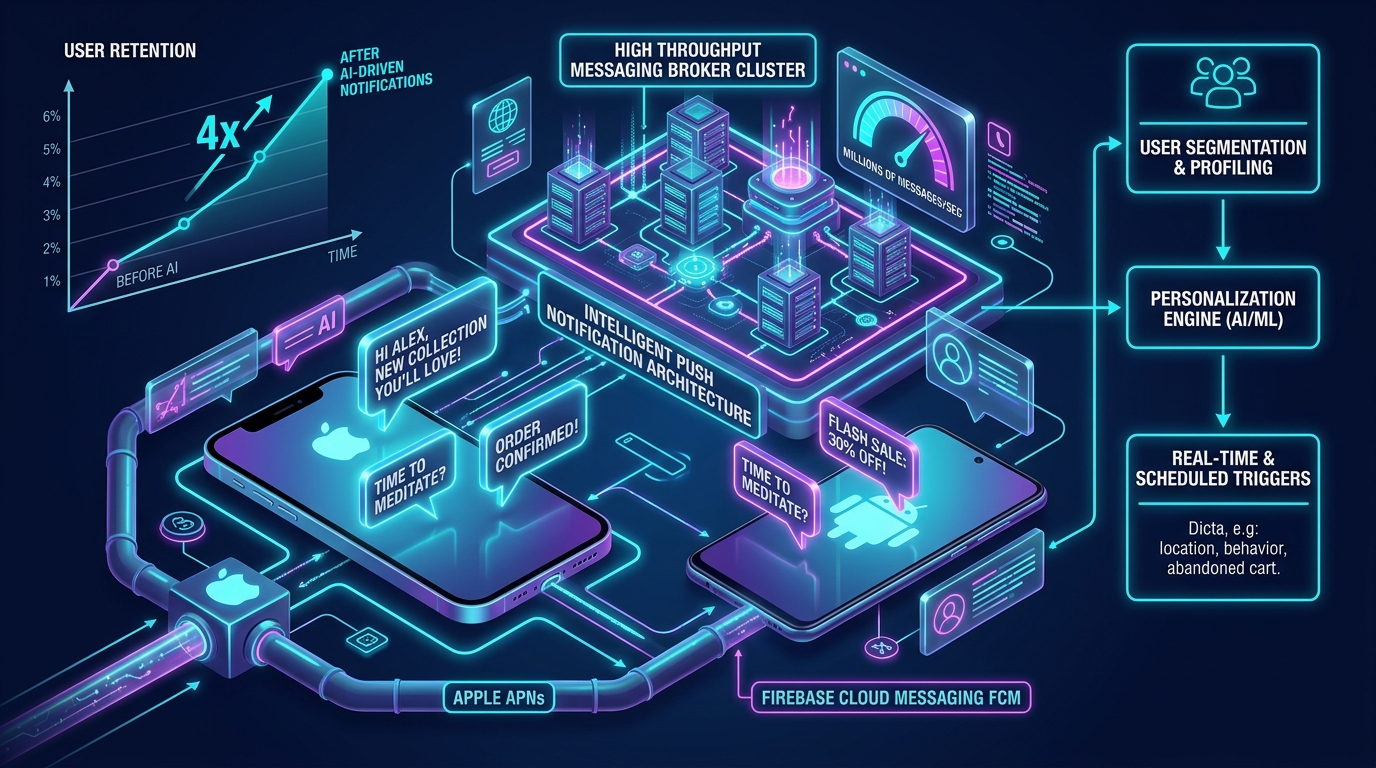
Delivering push notifications at scale requires a multi-tier cloud messaging architecture. On Apple devices, notifications route through Apple Push Notification service (APNs). On Android and cross-platform clients, messages route through Google Firebase Cloud Messaging (FCM).
When an app launches, it registers with the device OS to generate a unique, cryptographically signed device push token. This token is securely transmitted to your backend database and associated with the authenticated user profile. When a notification event triggers—such as an order status change, a chat reply, or an abandoned checkout reminder—the backend dispatches an authenticated HTTP/2 payload to APNs or FCM.
To process millions of notifications without choking primary database servers, production architectures utilize distributed queue brokers (such as Redis, RabbitMQ, or AWS SQS) paired with horizontal worker fleets that batch and rate-limit API calls to external push gateways.
Behavioral Segmentation and Localized Time-Zone Delivery
The difference between 2% and 20% notification click-through rates lies in behavioral segmentation and intelligent timing. High-converting push pipelines track user event streams—such as specific categories browsed, features used, and transaction recency.
Furthermore, notifications must respect user sleep cycles. Delivering a promotional ping at 3:00 AM is the fastest way to provoke an immediate uninstall. Intelligent messaging engines calculate localized device time zones, scheduling deliveries during peak engagement windows: morning commute hours (8:30 AM – 9:30 AM), lunch breaks (1:00 PM – 2:00 PM), and evening leisure hours (7:30 PM – 9:00 PM).
Deep Linking Architecture: Seamless Destination Routing
A notification that merely opens the app home screen creates immediate user drop-off. If a notification announces, "Your order #10842 has arrived at the local dispatch hub", clicking that notification must route the user directly to the live tracking map for order #10842.
This seamless navigation is enabled by Universal Links (iOS) and App Links (Android) paired with custom in-app deep linking routers. The notification payload includes structured metadata keys (such as {"action": "order_tracking", "order_id": 10842}). The app entry point parses these parameters upon launch, bypassing top-level screens and mounting the target view instantly.
Compliance, Opt-In Strategies, and Notification Channel Management
Modern iOS and Android versions enforce strict permission models. On iOS, apps must explicitly request notification permissions via system prompts. On Android 13+, the POST_NOTIFICATIONS runtime permission requires similar explicit consent.
Leading applications never trigger the raw OS permission dialog on initial app launch. Instead, they present an elegant in-app pre-permission primer explaining the tangible value the user will receive (e.g., "Enable alerts for instant flight delay warnings and exclusive flash deals"). Once the user clicks "Enable", the official system dialog is displayed, maximizing opt-in approval rates.
Supercharge Your App Retention with Deep11 Compusoft
Deep11 Compusoft architects end-to-end mobile engagement ecosystems. From high-throughput FCM/APNs cloud infrastructure and deep linking routing to automated behavioral segmentation funnels, we help you build mobile apps that keep users coming back.
Strategic Implementation Best Practices & Architectural Checklist
When executing enterprise-level projects in Mobile Apps, software architects and engineering leaders must adhere to a disciplined governance framework. Rushing deployment without standardizing code quality, automated testing, and security controls leads to compounding technical debt and production instability.
- Phase 1 — Discovery, Discovery & Schema Auditing: Conduct deep code inspections, audit relational database schemas for indexing bottlenecks, map undocumented API dependencies, and eliminate dead code paths before writing new features.
- Phase 2 — Modular Decoupling & Component Isolation: Break monolithic workflows into independently deployable, modular services using domain-driven design (DDD) principles. Establish strict contract boundaries via documented OpenAPI / Swagger specifications.
- Phase 3 — Automated CI/CD & Defensive Test Harnesses: Integrate static analysis (PHPStan / ESLint / SonarQube), automated unit and integration tests, and security linting into continuous integration pipelines to catch regressions before code touches staging environments.
- Phase 4 — Real-Time Telemetry & Observability: Deploy application performance monitoring (APM) tools, structured JSON logging, and error tracking daemons (Sentry, Prometheus, Grafana) to detect micro-bottlenecks and slow SQL queries proactively.
- Phase 5 — High-Availability Cloud Infrastructure: Configure automated horizontal autoscaling, Redis cluster memory caching, database read replicas, and Cloudflare CDN edge caching to sustain unexpected traffic surges without downtime.
Measurable Commercial & Engineering ROI
Investing in modern, disciplined engineering for Push Notification Architecture: How Intelligent Messaging Drives 4x Higher Retention in Mobile Apps delivers quantifiable operational and commercial returns across the organization:
- Substantial Throughput Acceleration: Average server response times drop by 50% to 75%, directly improving user retention and Google search ranking metrics.
- Drastic Reduction in Technical Debt: Clean architectural patterns reduce developer onboarding times from months to weeks, enabling your product teams to ship high-priority features twice as fast.
- Elimination of Security Vulnerabilities: Adherence to OWASP Top 10 guidelines, parameterized SQL queries, strict CSRF validation, and encrypted session handling protects your enterprise from catastrophic data breaches.
- Lower Cloud Infrastructure Footprint: Efficient query indexing and in-memory Redis caching reduce database CPU utilization, lowering monthly AWS / Google Cloud hosting expenses by up to 40%.
"World-class software engineering is not merely about writing code; it is about crafting resilient, maintainable digital assets that create unfair competitive advantages for your business."
— Deep11 Compusoft Solutions Architecture Council
Ready to Build or Scale Your Mobile Apps Project?
Our senior software architects, full-stack engineers, and cloud consultants specialize in delivering mission-critical web, mobile, ERP, and digital marketing solutions with guaranteed delivery milestones.