Unlock the cognitive science behind high-converting web design. Learn how strategic visual hierarchy, trust anchors, and friction reduction turn passive website visitors into qualified business leads.
The Invisible Barrier: Why Beautiful Websites Frequently Fail to Convert
In digital business, visual aesthetics alone do not guarantee commercial success. Thousands of enterprises invest heavily in striking web layouts, custom 3D animations, and trendy color palettes, only to wonder why their monthly inbound inquiry count remains stagnant. The disconnect lies in a fundamental misunderstanding of user cognition: visual aesthetics attract initial attention, but visual hierarchy directs commercial action.
Conversion Rate Optimization (CRO) is the disciplined practice of designing digital interfaces to systematically guide visitor attention toward high-value business outcomes—such as submitting an inquiry, scheduling a technical consultation, or purchasing a subscription. When visual hierarchy is absent, visitors experience cognitive overload: their eyes wander aimlessly across competing buttons, dense blocks of unformatted text, and confusing navigation links before abandoning the tab.
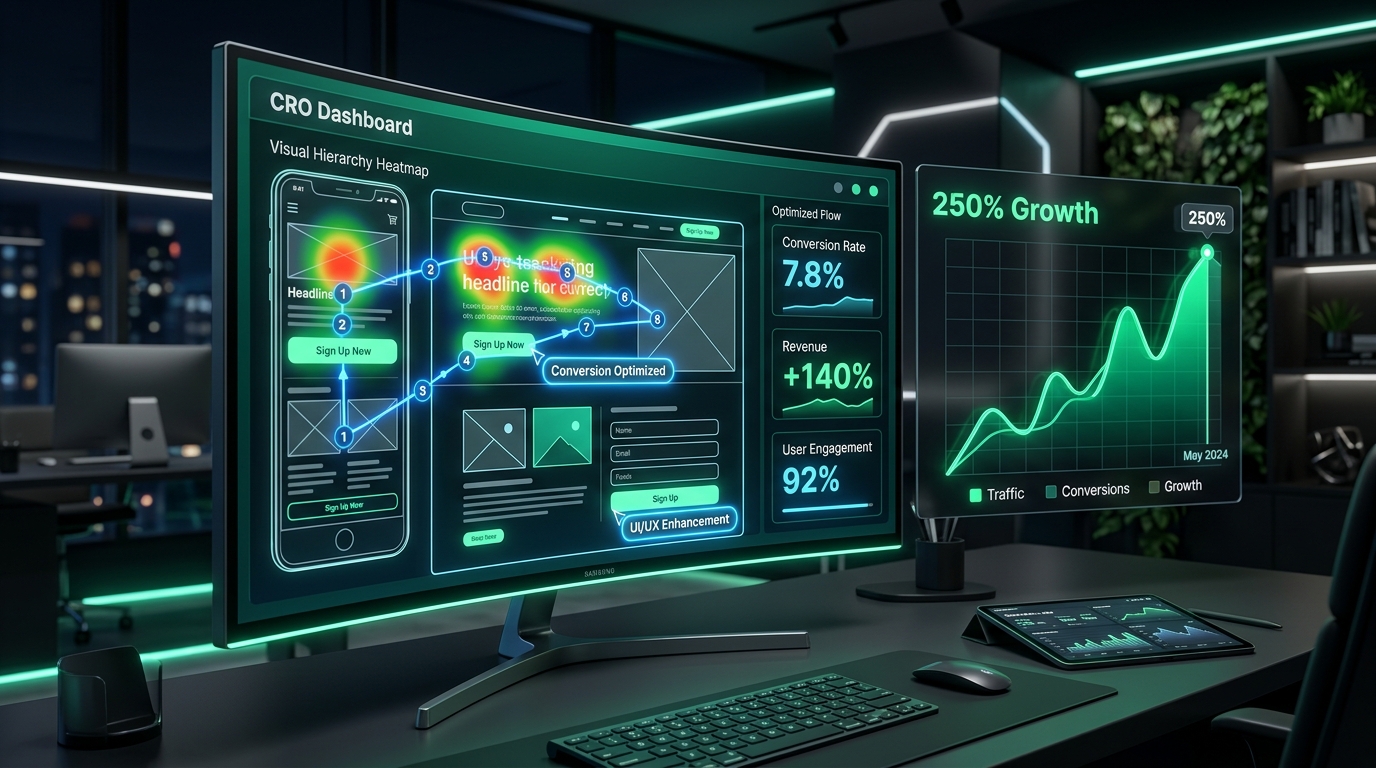
By applying scientifically validated principles of visual perception, color psychology, and cognitive ergonomics, modern web designs can increase lead conversion rates by over 250% without spending an additional rupee on advertising acquisition.
The Psychology of Eye Tracking: Mastering F-Patterns and Z-Patterns
Eye-tracking lab studies conducted by Nielsen Norman Group reveal that digital readers rarely read every word on a webpage. Instead, they scan interfaces following predictable physiological eye movement trajectories: the F-Pattern on text-heavy content and the Z-Pattern on visual landing pages.
In the Z-Pattern layout, a visitor starts scanning at the top left (where the brand logo establishes identity), moves horizontally across the header to the top right (where a prominent Call-to-Action button must reside), sweeps diagonally downward through the central hero value proposition, and finally lands on the bottom right where the primary action form or button is positioned.
Strategic designers place critical trust signifiers, primary value propositions, and conversion triggers precisely along these natural eye paths. Secondary details—such as policy links or supplementary feature descriptions—are intentionally deprioritized to preserve visual clarity.
Color Contrast, Scale, and the Principle of Isolation
Visual hierarchy relies on deliberate contrast in scale, color, whitespace, and typographic weight. The von Restorff Effect (also known as the Isolation Effect) dictates that when multiple similar items are presented, the one that differs from the rest will be remembered and clicked.
Many corporate websites dilute their primary conversion trigger by applying the same accent color to navigation bars, social media icons, section headers, and submit buttons. When everything is highlighted, nothing stands out. In high-converting design systems, the primary action color is reserved exclusively for conversion triggers.
Whitespace (negative space) is an equally critical architectural tool. Surrounding a key form or consultation button with generous whitespace signals high priority to the subconscious brain, making the action feel inviting, approachable, and frictionless.
Form Friction Elimination and Micro-Commitments
Forms are the ultimate gateway where website traffic converts into commercial pipeline. Yet, conventional web forms are often laden with unnecessary friction: asking for redundant physical addresses, company sizes, fax numbers, and complex multi-character passwords.
Every additional form field reduces conversion probability by an estimated 8% to 12%. High-converting websites ruthlessly prune input fields to the essential minimum required to qualify and respond to an inquiry: Name, Business Email, Phone Number, and Project Scope.
Furthermore, incorporating smart micro-interactions—such as inline real-time validation, floating label animations, and single-click autofill—lowers user anxiety and guarantees high completion rates.
Trust Architecture: Social Proof, Client Logos, and Verification Badges
In B2B services and enterprise technology, prospective clients evaluate vendors under significant risk aversion. Choosing the wrong engineering partner can result in missed release deadlines and wasted capital. Therefore, conversion architecture must continuously reinforce psychological safety.
Embedding quantifiable social proof—such as verified Google reviews, client logos, case study metrics (e.g., "Scaled revenue by 300% in 90 days"), and security certifications (ISO 27001, SSL)—directly beside high-stakes conversion points eliminates hesitation at the crucial moment of decision.
Transform Your Conversion Rates with Deep11 Compusoft
At Deep11 Compusoft, our UI/UX design philosophy fuses aesthetic excellence with conversion engineering. We conduct comprehensive UX audits, build high-converting responsive interfaces, and craft frictionless lead capture funnels that turn your website into a 24/7 revenue generation engine.
Strategic Implementation Best Practices & Architectural Checklist
When executing enterprise-level projects in UI/UX Design, software architects and engineering leaders must adhere to a disciplined governance framework. Rushing deployment without standardizing code quality, automated testing, and security controls leads to compounding technical debt and production instability.
- Phase 1 — Discovery, Discovery & Schema Auditing: Conduct deep code inspections, audit relational database schemas for indexing bottlenecks, map undocumented API dependencies, and eliminate dead code paths before writing new features.
- Phase 2 — Modular Decoupling & Component Isolation: Break monolithic workflows into independently deployable, modular services using domain-driven design (DDD) principles. Establish strict contract boundaries via documented OpenAPI / Swagger specifications.
- Phase 3 — Automated CI/CD & Defensive Test Harnesses: Integrate static analysis (PHPStan / ESLint / SonarQube), automated unit and integration tests, and security linting into continuous integration pipelines to catch regressions before code touches staging environments.
- Phase 4 — Real-Time Telemetry & Observability: Deploy application performance monitoring (APM) tools, structured JSON logging, and error tracking daemons (Sentry, Prometheus, Grafana) to detect micro-bottlenecks and slow SQL queries proactively.
- Phase 5 — High-Availability Cloud Infrastructure: Configure automated horizontal autoscaling, Redis cluster memory caching, database read replicas, and Cloudflare CDN edge caching to sustain unexpected traffic surges without downtime.
Measurable Commercial & Engineering ROI
Investing in modern, disciplined engineering for Conversion Rate Optimization (CRO) in Web Design: How Visual Hierarchy Boosts Inquiries by Over 250% delivers quantifiable operational and commercial returns across the organization:
- Substantial Throughput Acceleration: Average server response times drop by 50% to 75%, directly improving user retention and Google search ranking metrics.
- Drastic Reduction in Technical Debt: Clean architectural patterns reduce developer onboarding times from months to weeks, enabling your product teams to ship high-priority features twice as fast.
- Elimination of Security Vulnerabilities: Adherence to OWASP Top 10 guidelines, parameterized SQL queries, strict CSRF validation, and encrypted session handling protects your enterprise from catastrophic data breaches.
- Lower Cloud Infrastructure Footprint: Efficient query indexing and in-memory Redis caching reduce database CPU utilization, lowering monthly AWS / Google Cloud hosting expenses by up to 40%.
"World-class software engineering is not merely about writing code; it is about crafting resilient, maintainable digital assets that create unfair competitive advantages for your business."
— Deep11 Compusoft Solutions Architecture Council
Ready to Build or Scale Your UI/UX Design Project?
Our senior software architects, full-stack engineers, and cloud consultants specialize in delivering mission-critical web, mobile, ERP, and digital marketing solutions with guaranteed delivery milestones.