
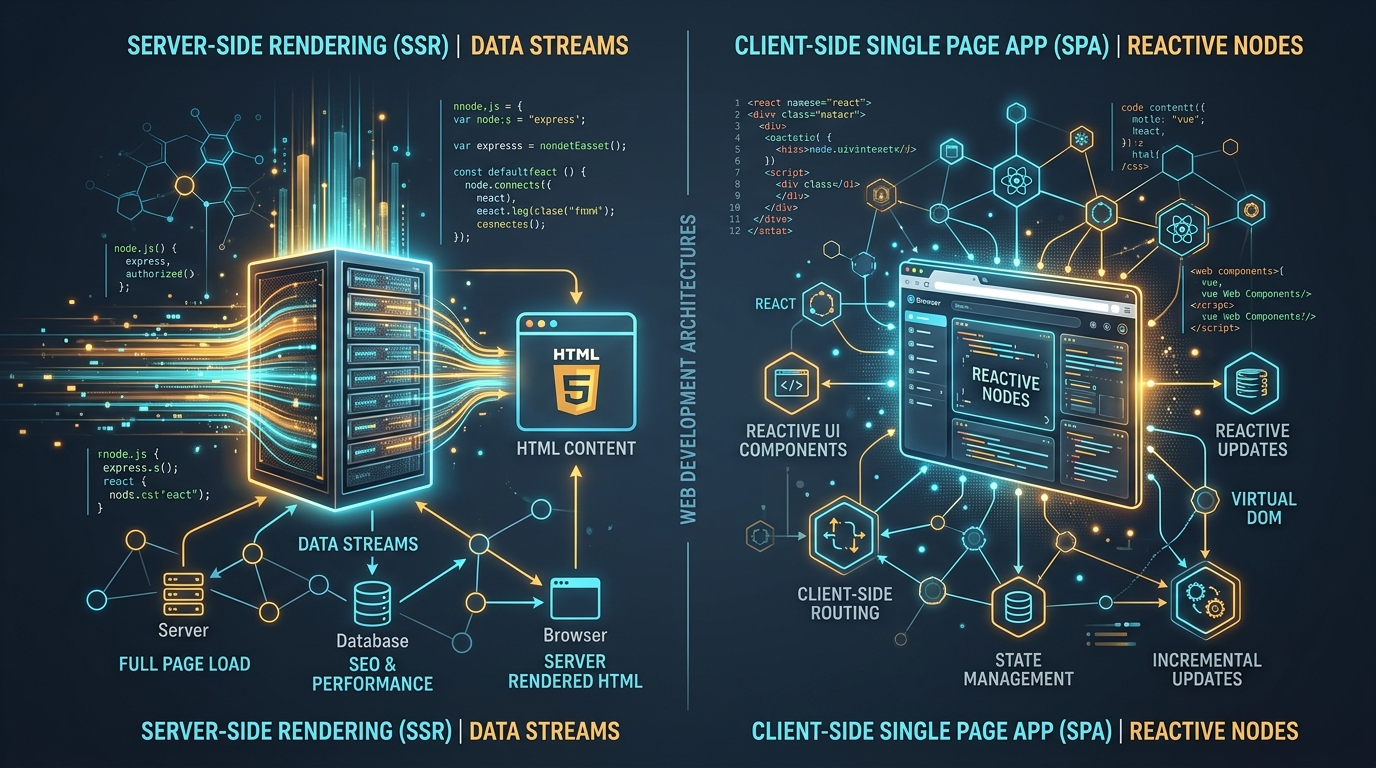
A rigorous technical comparison between Server-Side Rendering (SSR) and Client-Side Single Page Applications (SPA). Learn which architecture maximizes Core Web Vitals, organic search indexing, and user experience.
The Architectural Dilemma: Where Should Your HTML Be Rendered?
In modern web development, few architectural decisions carry more lasting consequences for organic discoverability, infrastructure overhead, and perceived user latency than the choice between Server-Side Rendering (SSR) and Client-Side Single-Page Applications (SPA). For the past decade, frontend ecosystems have swung between these two paradigms, each offering distinct tradeoffs.
Client-Side SPAs revolutionized web development by shifting UI rendering entirely to the browser runtime using frameworks like React, Vue, and Angular. Once downloaded, client applications deliver snappy transitions without full page reloads. However, this convenience comes at a heavy cost: initial blank-screen delays, massive JavaScript bundles, and significant search engine crawler indexing penalties.
Conversely, Server-Side Rendering generates complete, semantic HTML on the web server before dispatching it to the client browser. Users and search engine crawlers receive immediately viewable text and imagery on the very first HTTP response packet, drastically accelerating First Contentful Paint (FCP) and Largest Contentful Paint (LCP).
Core Web Vitals Breakdown: FCP, LCP, INP, and CLS
Google has codified web performance into Core Web Vitals—a set of empirical user experience metrics directly tied to organic search ranking algorithms. Evaluating how SSR and SPA architectures perform against these metrics reveals clear divergence.
Largest Contentful Paint (LCP) measures how quickly the primary content of a webpage becomes visible. Pure SPAs suffer on LCP because the browser must sequentially download the HTML skeleton, fetch external JavaScript bundles, parse and execute the script, fire secondary API calls, and finally render DOM nodes. On 4G mobile connections or budget devices, this cascade frequently pushes LCP beyond 3.5 seconds, triggering Google search ranking penalties.
Server-Side Rendered architectures consistently achieve LCP times below 1.2 seconds. Because the server compiles database records into HTML prior to transmission, the browser paints critical hero banners and typography immediately upon HTML reception, even before interactive JavaScript hydration finishes.
Search Engine Crawling and Indexing Realities
While Googlebot has incorporated headless Chromium rendering to evaluate client-side JavaScript, reliance on client-side rendering for organic search visibility remains an immense business risk. Rendering JavaScript requires substantial compute resources, leading search engines to allocate strict "crawl budgets" to websites.
When a crawler encounters a pure SPA, it frequently indexes the initial blank HTML payload and queues the JavaScript rendering phase for days or weeks later. In dynamic industries where pricing, availability, and articles change rapidly, this indexing lag causes revenue-destroying drops in organic search visibility.
Furthermore, non-Google search engines (such as Bing, DuckDuckGo, and international engines like Baidu and Yandex) have far more limited JavaScript execution capabilities. For global platforms and content-rich digital portals, server-rendered semantic HTML remains the undisputed gold standard for universal discoverability.
When SPAs Make Sense: Highly Interactive SaaS Dashboards
Despite the SEO advantages of SSR, Single-Page Applications remain the premier architectural pattern for authenticated, data-intensive web software where organic search crawling is irrelevant. Enterprise SaaS platforms, real-time collaboration suites, video editors, and complex workflow dashboards thrive on client-side state management.
In these applications, initial load times are secondary to fluid client-side responsiveness. Once the authenticated application shell loads, users can manipulate complex canvas elements, filter tens of thousands of data points locally, and transition between administrative subviews with zero network latency.
The Modern Hybrid Consensus: Islands Architecture and Progressive Enhancement
Modern engineering teams no longer face a binary choice between pure SSR and pure SPA. Advanced modern frameworks—including Laravel Blade with Alpine.js, Next.js App Router, and Astro—enable hybrid architectural patterns often termed "Islands Architecture" or progressive enhancement.
Under this modern paradigm, marketing pages, blog articles, and e-commerce product catalogs are rendered statically or server-side for instantaneous SEO and rapid Core Web Vitals. Interactive widgets—such as dynamic shopping carts, interactive pricing calculators, and live search bars—hydrate as isolated, lightweight reactive islands without bloating the global page bundle.
Architect Your Web Strategy with Deep11 Compusoft
At Deep11 Compusoft, we tailor architectural decisions to your precise commercial objectives. Whether your priority is maximum organic search visibility and sub-second Core Web Vitals or building complex, reactive enterprise SaaS applications, our engineering teams deliver robust solutions built for sustained growth.
Strategic Implementation Best Practices & Architectural Checklist
When executing enterprise-level projects in Web Development, software architects and engineering leaders must adhere to a disciplined governance framework. Rushing deployment without standardizing code quality, automated testing, and security controls leads to compounding technical debt and production instability.
- Phase 1 — Discovery, Discovery & Schema Auditing: Conduct deep code inspections, audit relational database schemas for indexing bottlenecks, map undocumented API dependencies, and eliminate dead code paths before writing new features.
- Phase 2 — Modular Decoupling & Component Isolation: Break monolithic workflows into independently deployable, modular services using domain-driven design (DDD) principles. Establish strict contract boundaries via documented OpenAPI / Swagger specifications.
- Phase 3 — Automated CI/CD & Defensive Test Harnesses: Integrate static analysis (PHPStan / ESLint / SonarQube), automated unit and integration tests, and security linting into continuous integration pipelines to catch regressions before code touches staging environments.
- Phase 4 — Real-Time Telemetry & Observability: Deploy application performance monitoring (APM) tools, structured JSON logging, and error tracking daemons (Sentry, Prometheus, Grafana) to detect micro-bottlenecks and slow SQL queries proactively.
- Phase 5 — High-Availability Cloud Infrastructure: Configure automated horizontal autoscaling, Redis cluster memory caching, database read replicas, and Cloudflare CDN edge caching to sustain unexpected traffic surges without downtime.
Measurable Commercial & Engineering ROI
Investing in modern, disciplined engineering for Server-Side Rendering (SSR) vs Single-Page Applications (SPA): Choosing the Right Architecture for SEO and Speed delivers quantifiable operational and commercial returns across the organization:
- Substantial Throughput Acceleration: Average server response times drop by 50% to 75%, directly improving user retention and Google search ranking metrics.
- Drastic Reduction in Technical Debt: Clean architectural patterns reduce developer onboarding times from months to weeks, enabling your product teams to ship high-priority features twice as fast.
- Elimination of Security Vulnerabilities: Adherence to OWASP Top 10 guidelines, parameterized SQL queries, strict CSRF validation, and encrypted session handling protects your enterprise from catastrophic data breaches.
- Lower Cloud Infrastructure Footprint: Efficient query indexing and in-memory Redis caching reduce database CPU utilization, lowering monthly AWS / Google Cloud hosting expenses by up to 40%.
"World-class software engineering is not merely about writing code; it is about crafting resilient, maintainable digital assets that create unfair competitive advantages for your business."
— Deep11 Compusoft Solutions Architecture Council
Ready to Build or Scale Your Web Development Project?
Our senior software architects, full-stack engineers, and cloud consultants specialize in delivering mission-critical web, mobile, ERP, and digital marketing solutions with guaranteed delivery milestones.